



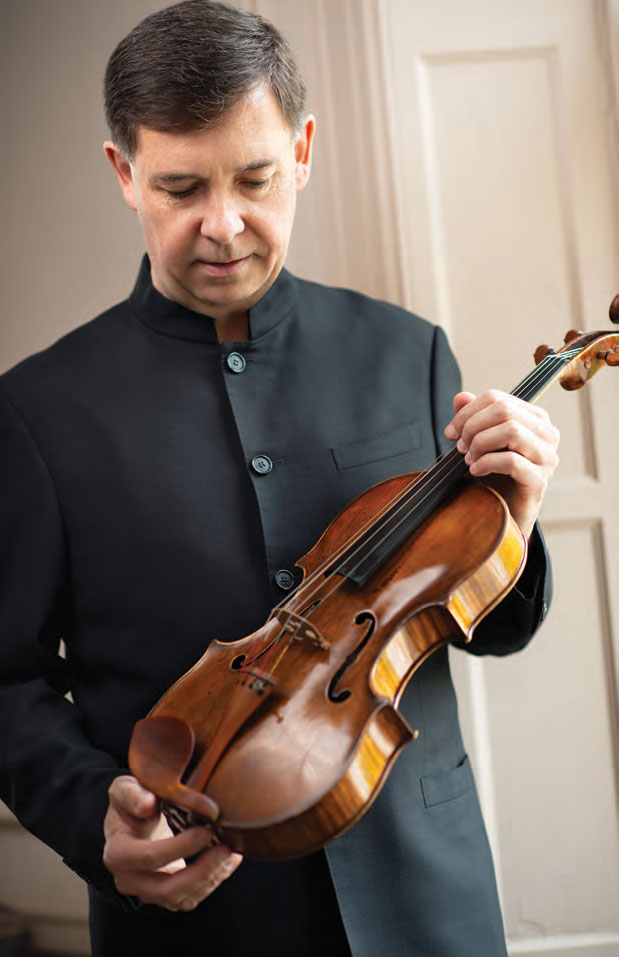
One of the world’s leading violists, Grammy Award-winning Roberto Díaz, talks about his role at the prestigious Curtis Institute of Music, his extensive orchestral involvement, and the importance of a veritable dedication to his métier.
TOne of the world’s leading violists, Grammy Award-winning Roberto Díaz, talks about his role at the prestigious Curtis Institute of Music, his extensive orchestral involvement, and the importance of a veritable dedication to his métier.
CEO of Curtis, Díaz combines such forces, strengthening and enriching the aptitude of today’s most polished emerging artists.
“My family and I came to the States when I was very young, but we only stayed for a year before going back to Chile. My father is also a violist, and in 1966, he attended Indiana University on a Fulbright Scholarship to study with William Primrose – who was probably the foremost violist in the 20th century – and sort of the first big superstar of the viola. In the early seventies, my father was invited to join the Atlanta Symphony, so we moved back, and I attended my middle and high school years here. Being from Chile shaped my interests, because what Latin American kid doesn’t want to be a soccer star at some point in their life. However, in that time period, that particular sport in this country wasn’t what it is now, with America being a destination for mega soccer stars, so it was almost disheartening to play in high school, and my curiosity disappeared. Both of my parents were musicians – my mother was a pianist – so all the children had to study music. Not necessarily as a career, but we had to have a musical education of some sort. I played violin a little bit when I was young, because at the time in Chile, there weren’t any youth orchestras, so the teaching was focused on instruments that could eventually become career opportunities. A lot of us learned violin, piano, guitar, singing… but I switched when we came to the States and became physically big enough to successfully play the viola.
I then went to the New England Conservatory where I studied with Burton Fine, who was at that time, the principal violist of the Boston Symphony, and from there I studied at Curtis for two years with Joseph de Pasquale, the principal violist for the Philadelphia Orchestra. I began working after that, starting in the Minnesota Orchestra for about a year, then the Boston Symphony. Then I went to Washington D.C. with Rostropovich as music director, where I was principal violist for about five years, only leaving when he finished his tenure, after which I joined the Philadelphia Orchestra with Wolfgang Sawallisch and also with Christoph Eschenbach. During my time in the Philly Orchestra, where I held the position of principal viola for ten years, I started teaching at Curtis, becoming the director soon after… and I’m abso-lutely delighted to be in my twenty-first year.”
Built on tradition and an aggregate objective to ensure that the most extraordinarily brilliant individuals reach their highest potential, the Curtis Institute of Music in Philadelphia recently celebrated its centennial anniversary. With a small student body comprised of 150-160 students, this highly selective, performance-based music conservatory instructs with a meticulous style of premier caliber. Originating in 2008, Curtis on Tour is a global initiative that embraces the school’s “learning by doing” philosophy, championing personal pursuits and enhancing the trajectory for professional achievements.
“Curtis opened its doors in 1924, and the school pretty much has been tuition-free for its entire history. When the school started, Leopold Stokowski was the music director of the Philadelphia Orchestra and Mrs. Curtis Bok, founder of the institution, was asked by Stokowski whether she would consider opening a music school that was modeled after the great old European conservatories. They understood that to make this a real meritocracy, whoever deserved to be at the school should have the capacity to attend. So, if you were talented enough to be admitted, you should be able to study there regardless of age, and holding true, we have students that are anywhere from twelve years old to late twenties… the school was imagined that way. Curtis is a school for performing musicians, and I thought that if we could tour around the country and different parts of the world, with students and alumni playing together, then it would give people a chance to see and hear the level of excellence that comes from the school. The program has helped raise visibility for the institution, and because Curtis is a truly international school, students come from all over the world. What this tour was also able to do was to make the board of trustees international, mirroring the student population. To choose our programming, we start with the question, where are we going, and then think about if we have been there before and what we played, always aiming to bring variety, because every orchestral instrument is represented at Curtis, as well as singers and composers. Once we start to get some sort of clarity on what the ensemble should be, we reach out to the faculty and let them know what we need, what the repertoire will be and see who they recommend. I don’t do all the tours, but we have around ten a year in different parts of the world, and have been to such fascinating places. I traveled a lot with the Boston Symphony and National Symphony Orchestra, personally going to Singapore, Japan, and China, and it’s really wonderful to take the students now and discover new traditions with them.”
In early March of this year, three virtuosos from Curtis unveiled their brilliance, filling the walls of the Coudert Institute of Palm Beach, Florida with a mellifluous air. Adrian Zaragoza exhibited profound control of the piano for the program’s duration, Tzu-Yi Yu captivated with precise articulation of the clarinet as he performed a Bernstein sonata, and the divinely euphonious soprano sounds of Sarah Fleiss impressed the au-dience with an authentic presence and effortless power that radiated through selections from West Side Story, Schubert’s “The Shepherd on the Rock,” and René Orth’s “Death is Nothing at All.” Díaz accompanied Zaragoza and Yu with his famed viola, as they played selections from Bruch for their final piece, whereupon all four performers bowed with gratitude to standing ovations and murmurs of overwhelming endorsement from the crowd, validating that Curtis is producing what will undoubtedly become the next wave of classical music industry giants.
The digital age has fundamentally transformed music, crafting an interdependent relationship that impacts every facet of the musical experience, from creation and performance to distribution and absorption.
“Some aspects of life you can’t fight against, but it’s how you use this modern technology that’s interesting, including the access that it’s created. These days, if you want to hear Primrose playing something he recorded in 1940, you simply type it into your phone and can listen to it. We even livestream some concerts from Curtis. In a full hall, there are about five hundred people, but you livestream the performance, and within weeks, one hundred thousand people have viewed it – it’s astounding.”
Díaz remains humble about his extraordinary accomplishments, optimistic that he will be dually acknowledged philanthropically.
“I’ve probably done eight to ten records for Naxos, (the world’s leading classical music label and distributor). The instrument that I play on is the ex-Primrose (Amati viola) – named after the man who my dad studied with. Primrose had an incredible performing career, and as was fashionable in his day, a lot of the famous personalities such as Heifetz and Piatigorsky arranged music for themselves. They would take an aria from an opera or a movement of a string quartet and make an arrangement for, in this case, viola and piano.
So, one of the first records I did for Naxos, because of the fact I had this viola, was a recording of Primrose transcriptions – and the only audio that existed was Primrose himself playing on this exact instrument.
That was the first record, and it was very successful… being nominated for a Grammy. The man who owned Naxos records, Klaus Heymann, got very enthusiastic about the recordings and wanted to do more. I happily obliged and went on to record Brahms sonatas, Vieuxtemps sonatas and solo pieces, concertos… so that was a wonderful experience. I feel a certain connection to Brahms – his music sort of strikes me in a distinct way, but when I’m playing Mozart Sinfonia Concertante then I think, well it doesn’t get a whole lot better than this. Practicing Bach, for me, is an amazing experience – there are so many folks out there who consider themselves experts on how to perform and interpret Bach. I don’t feel that way, but I do enjoy continuing and learning from it, because it’s important to understand that what we do is not a sprint – it’s a marathon, and you will forever have to keep honing your skills… we practice all the time. Learning an instrument is a long process that requires much thought, and it teaches you to teach yourself. I think it’s a wonderful thing when young people are introduced to jazz, singing, guitar, classical music… so many skills are developed by that – one of the biggest is patience. Ultimately, life is about what we do for others. Running an institution like Curtis is complicated, and you hope after all is said and done, the good you leave behind will be valued. I hope that people will remember the work that we did for young people… to inspire a new generation.”
**To learn more about the Curtis Institute of Music and for all upcoming tour schedules, please visit www.curtis.edu