




PHOTOS COURTESY OF THRULINE ENTERTAINMENT AND INDIGO RIVER PUBLISHING
Composing dialogue for some of the most highly recognizable and talented women to ever grace the small screen, Golden Globe nominee and decorated writer/producer Stan Zimmerman duly merits a standing ovation. With a new book, The Girls: From Golden to Gilmore, and an off-Broadway play, this mastermind of expression opens up about being on stage himself, early struggles with coming out, and what being a writer in Hollywood can implicitly demand.
Sipping from a Luke’s Diner mug (Gilmore Girls) and donning a Golden Girls shirt, you can tell Zimmerman is proud of his work… deservedly so. Speaking candidly, with a smile that belongs in show business just as much as his scripts do, we initially explored his new stage production, Right Before I Go, which recently debuted at The Tank NYC.
“In 2012 a very close friend died of suicide and he left a note. Four friends were mentioned in the note, which I was one of, but the person he sent it to wouldn’t give it to the rest of us. I didn’t really know how to process all of it, so I started googling about suicide, and thought that maybe if I had other people’s notes, then I would come into the “why.” There was still so much shame around the subject, and I had an idea about how I could use my art to help end the shame. It’s very emotional reading those notes, and I found that it was hard to understand how those people could be so eloquent in their writing at such a turbulent time in their lives. I put the play up at the 2015 Hollywood Fringe Festival, and before we opened, some cast members said, ‘You know, it’s really hard hitting,’ and I said, ‘Good,’ and they answered, ‘Well, you have to give audiences hope.’ To which I replied, ‘I do?’ So, what I ended up doing was finding notes from people that attempted it, but lived. They talked about how they were glad they survived, and living for what’s around the corner. So the play ends on hope and love… and there is some humor, because I may have added a funny line here and there.
The only thing I ever took from set were the memories
I had never written alone, and I was quite honestly afraid to open my heart – but I had to – and then the narrator of the play became me. When I got to my friend’s name, it got stuck (in my throat) but I’ve been doing it ever since. I’m up on the stage with Emmy-winning and Tony-nominated actors, and I sometimes have to pinch myself when I look around. This play gives us all a chance to move the needle and provoke conversation… it’s been wonderful.”
Zimmerman may call the Hollywood Hills home now, but fondly remembers his Midwestern, Detroit, Michigan upbringing and New York college days.
“My idol Lily Tomlin came from Detroit as so many creative people do, but we usually get out of there. I was all set to go to the University of Michigan because that’s where all my aunts, uncles, parents, and brother went, but I had my eyes set on New York City and their theater programs. The most important person in my life was my mother. She was my biggest cheerleader, fought for me, and worked super hard to get money that allowed me to attend NYU – which wasn’t easy for a divorced single mom with three kids. But she really believed if that was my dream she would make it work. She told me, ‘You have to be positive that’s what you want to do and nothing else,’ and asked me to go think about it. I remember going to sit on my bed for a whole three seconds before telling her I was sure, and she said, ‘Let’s do it.’
Luckily, I got into NYU where I met my writing partner (James Berg) and we started writing sitcoms in between after-school jobs and classes. We got an agent, this young guy, who only handled newscasters and us, and he got our scripts out to Los Angeles. I was working in a casting office my senior year of college when we got a call that a development executive at Paramount read our script, really liked it, and wanted to know if we would ever be coming to L.A. to meet him. I was sick of being poor in New York, and Jim was going out to a family function, so I tagged along and we started taking meetings. Within a year, we were on staff for an ABC (Network) sitcom.
I didn’t read much as a kid, so I didn’t think I could ever be a writer. I knew I had ideas, but I didn’t consider myself literary. In English class I kind of rebelled. I thought that the more adjectives you used the better grades you would get, and I said to myself, ‘No, I’m not doing that. I’m going to write direct and to the point.’ True to that, I did not get the best grades in English, but in television you have to be to the point. You have twenty-three minutes, so you can’t write all flowery. I was actually training myself and didn’t know it. But I knew the concept of writing with somebody else. When I was in New York, I thought maybe there was someone who could compliment me that was a wordsmith… and I visualized Jim, who happened to be a journalism major. I would act the parts and have the motivation of the character, which was funny because when we got on Golden Girls, he would say to me ‘Read the line,’ and I would have to become Blanche with a southern accent.”
This play gives us all a chance to move the needle and provoke conversation
Even though the powerhouse writing team of Zimmerman and Berg eventually became unstoppable, progressing to that phase didn’t come without a few hitches.
“We never felt like we were welcomed on the set of Golden Girls – we were the only writers with those director chairs that didn’t have our names on them. Something as little as that, really taught us early in our careers that acknowledgement of every single person is important… everyone contributes. We took those lessons, although it hurt us at the time, of how we would run our own show. Estelle (Getty) was the most fun, because in my mind I visualized her as a really good baseball player. She would come up – and you could just hear the crack of that bat, and the ball would go over the wall – outside the stadium. But the other side to that, was you couldn’t just write mediocre jokes for her, or any of them. Those were four of the funniest women on television, which is why we’re still talking about the show forty years later – and it’s bigger than ever. They were the best of the best, so we had to write the best of the best jokes.
Back in Lucille Ball’s day, the multi-camera television show was a very popular format and was sort of pioneered by her. It’s shot in front of a live-studio audience so there’s the audience in the bleachers, the cameras, and three or four sets in a row, but done like a play… and I had all the training in that. In a single-cam, there’s no audience – so no laughter, which is like a movie, so you’re not sure where the laughs are. In a multi-cam, if the audience doesn’t laugh, the writers have to huddle and come up with a new joke on the spot, which can be very intimidating. I like rehearsing and figuring it out, being funny at the snap of a finger isn’t something I love to do. As the years progressed, we came up with alternative jokes, so if one didn’t hit, there was three or four to have something to work with in editing… and if the actors had been good to us, they could pick their favorite.”
But how is it possible that Zimmerman captures the female essence and can write so accurately for numerous leading ladies?
“I learned early on, around seven and a half, to observe others. I was a sensitive child, so I could always empathize with people. I think you grow as a person, and as a community and society, by putting yourself in someone else’s shoes to see how they feel. Obviously there’s no way I can know what it’s truly like to be a woman and walk in a woman’s shoes. Even if I did put on those shoes, I might only be able to feel the pain of some of those heels… but I’m always curious what it is really like to be anyone, in both good and scary environments.
When we were starting out, there wasn’t any diversity or openness. On Golden (Girls) we couldn’t say we were gay, and had to bring women as companions to every function. People find that shocking because it’s such a progressive show, but it was just a different time. There was this fear, which seems so crazy and unfounded… what would really happen if they found out? Would we be fired? I just didn’t know. When we came to Hollywood, there was the “old boy’s network,” and I remember hearing stories about the writing staff on Happy Days and Laverne and Shirley, that in between breaks they would play basketball and I thought, I can’t do that – I’m a writer, and I equated the two together… so there was that period. To me, I would be happiest if I could be on a staff with just myself, Jim, and all women writers. That would be the ultimate.”
Comedy-drama Gilmore Girls is having a moment. This year, the TV show celebrated its 25th anniversary with several events, including a reunion of Lauren Graham and Alexis Bledel at the Emmy Awards. Zimmerman lent his poetic genius to the fast-paced discourse, breathing life into the characters, and contributing to the show’s unrelenting success.
“Amy Sherman-Palladino wrote a brilliant pilot and cast the show exceptionally well. Lauren Graham was so perfect, Kelly Bishop, Melissa McCarthy, Sally Struthers, I could go on and on. We met Amy on Roseanne, and became really close friends. She took a lot of techniques from sitcom writing and put them into the hour format. In sitcoms, there’s usually an arc and the scene will end with a joke. In hour shows that’s not normally done, but she always adds a little bow to the end of scenes. Her style of writing is so subtle, and I love the way she plants seeds of storylines so later on they can grow into something bigger. Like the character Logan… Rory could just bump into him – suddenly he’s at the newspaper, then suddenly they’re dating, and then they’re stealing cereal… which is one of our episodes. Stars Hollow is a bunch of oddballs, yet they still form a community, and if you think about it – that’s really the world, but you rarely see that on a show. Maybe Northern Exposure or St. Elsewhere, which I love, but you very rarely saw a single town like that. Then you throw in this mother and daughter struggling to survive on their own, when Lorelai could have taken the easy way out, but chose instead to start over and create a new life… and Amy had envisioned them more like sisters – which is very important.
When I saw Roseanne first come on the scene, when she did her stand-up on The Tonight Show, I thought, who is this person? We just hadn’t seen anybody who talked like that. Her comedy was very dry, and she did not talk about her kids preciously. We asked our agent to get us a meeting with this Roseanne woman, and he said, ‘No one will ever make a show about someone who looks like that.’ Well, needless to say he wasn’t our agent much longer, but that was television back then. It was all very blond and traditionally good-looking people, whatever that means. So when she ended up hitting it big and got her series we were offered Season 1, but wound up turning it down because we were developing our own shows and wanted to flex that muscle. They (Roseanne) were offering a seven-year contract, and we weren’t sure about being locked down for that long. But when the opportunity came back again in Season 5, we jumped at it. We loved her storytelling, and being a Midwestern kid, that was how I grew up. They did say to us at the initial meeting, ‘We do not pat people on the back here.’ At the time, we wanted the job so we said ‘Ok,’ but everybody needs that encouragement. She (Roseanne Barr) didn’t trust the writing staff or producers, barred the network from coming to the show, and we were told, ‘Don’t let her see the whites of your eyes or she’ll fire you,’ so I would find the tallest person on set and hide behind them. The first day of the first filming there were twenty-one writers, and her and Tom Arnold brought in t-shirts with numbers on them, and had all the writers get in line for a shirt. My birthday is the thirteenth, so I thought… I have to get that number. Turns out, they had bought those shirts so they didn’t have to learn our names, and they could just point and say, ‘Hey number whatever, you’re fired.’”
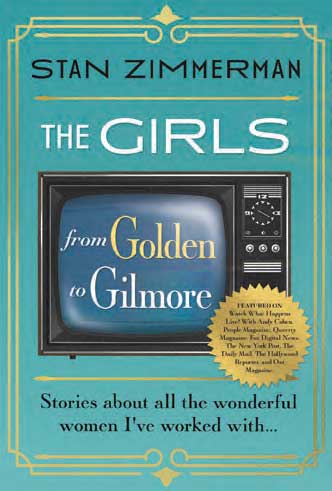
Zimmerman’s autobiography The Girls: From Golden to Gilmore details more anecdotes both professional and personal, but there’s always one question everyone seems to want to know – Did you ever keep anything from a set?
“No. I wish I had from the Brady Bunch movies, that would have been fun to have but, and this is going to sound corny, but the only thing I ever took from set were the memories. I used to take a lot of pictures with my disposable camera… my mom would come to the Roseanne set and want to sit on the couch, and I said, ‘Ok – just don’t look at or talk to anybody!’ When we had our own shows she thought it was amazing that we got to hire so many people and we were able to create this wonderful family you got to come back to week after week. That was the best part of it all.”